

Before applying to register a trademark in Pakistan, it is sensible to find out whether an identical or confusingly similar trademark is already recorded in the relevant class. A preliminary trademark search can reduce the risk of filing an application that later faces an objection because of an earlier mark.
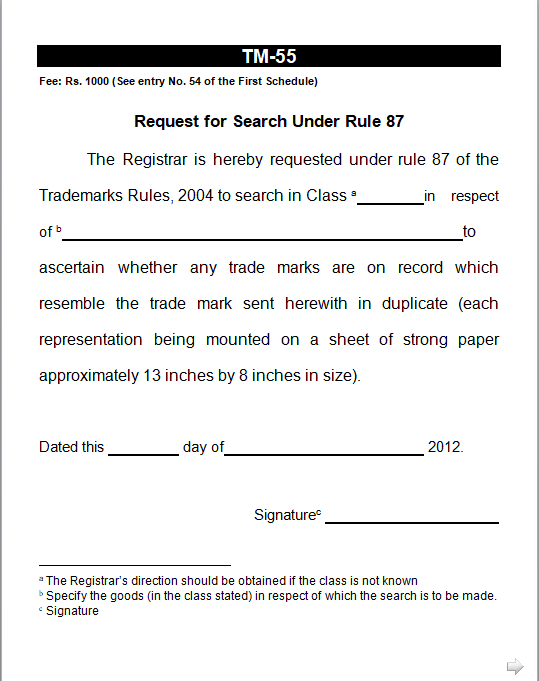
Form TM-55 is the prescribed form traditionally used to request an official trademark search from the Trade Marks Registry of the Intellectual Property Organization of Pakistan, commonly known as IPO-Pakistan. The form is titled “Request for Search Under Rule 87” and asks the Registrar to search the official records for marks resembling the trademark submitted by the applicant.
This guide explains the purpose of TM-55, how to complete each part of the form, how trademark classification affects the search, and what to do after receiving the search result.
What Is Form TM-55?
TM-55 is a request asking the Registrar of Trade Marks to conduct a search under Rule 87 of the Trade Marks Rules, 2004. Its purpose is to determine whether the official records contain trademarks that resemble the proposed trademark in relation to specified goods or services.
The form does not register a trademark. It is only a search request.
A trademark search and a trademark registration application are separate stages. A favourable search result does not automatically give the applicant ownership of the mark, nor does it guarantee that a later registration application will be accepted.
The search is normally conducted in relation to a particular class of goods or services. If a business intends to use its trademark in more than one class, separate searches or fees may be required for each class according to the procedure applicable at the time of filing.
Why Should You Conduct a Trademark Search?
A trademark may be refused or opposed if it is identical or confusingly similar to an earlier trademark covering the same or related goods or services. Searching before filing can help identify this risk.
A preliminary search can help an applicant:
- Check whether an identical mark appears in the records.
- Identify similar names, spellings or logos.
- Assess whether the proposed brand is sufficiently distinctive.
- Avoid investing heavily in a brand that may be difficult to register.
- Reduce the possibility of objections, opposition or rebranding costs.
- Make a better-informed decision before filing a registration application.
For example, a person planning to launch a clothing brand may spend money on packaging, signage, advertising and social-media promotion. If another party already owns a similar trademark for clothing, the new business may have to change its name after incurring substantial costs. Conducting a search early can reduce this commercial risk.
Is a TM-55 Search Mandatory?
A pre-filing trademark search is generally a precautionary step rather than the act that creates trademark rights. An applicant may proceed with a registration application without first requesting a TM-55 search, subject to the prevailing requirements of IPO-Pakistan.
However, filing without an adequate search may expose the applicant to avoidable risks. The Trade Marks Registry will examine the application independently, and an earlier rights holder may oppose it after publication.
Therefore, a search is strongly advisable, especially when:
- The proposed brand is important to a new business.
- Considerable money will be spent on launching or marketing the brand.
- The name consists of commonly used words.
- Similar businesses already use comparable names.
- The applicant intends to operate nationally.
- The trademark will be licensed, franchised or used for exports.
- The applicant plans to register both a word mark and a logo.
Understanding the Trademark Class
One of the most important blanks on TM-55 is the trademark class.
Trademarks are classified according to the goods or services for which they are used. The international Nice Classification divides goods and services into 45 classes: Classes 1 to 34 generally cover goods, while Classes 35 to 45 generally cover services.
Examples include:
- Class 9: software, downloadable applications and certain electronic goods.
- Class 25: clothing, footwear and headgear.
- Class 30: coffee, tea, flour, bakery products and certain food products.
- Class 35: advertising, business management and retail-related services.
- Class 41: education, training, entertainment and sporting activities.
- Class 42: scientific, technological and software-related services.
- Class 45: legal and certain personal or security services.
Selecting the correct class is essential because the search is conducted in relation to the specified goods or services. A search in an incorrect class may fail to reveal the most relevant conflicting marks.
The form itself notes that the Registrar’s direction should be obtained if the class is not known. In practice, an applicant should carefully examine the current classification or obtain professional advice before submitting the request.
A business may also require more than one class. For instance, a software company might need protection for downloadable software in Class 9 and software-as-a-service in Class 42. A training provider may need Class 41, while business consultancy services may fall within Class 35.
How to Fill Form TM-55
TM-55 is a short form, but every entry should be completed carefully and consistently.
1. Enter the Trademark Class
The main paragraph states:
“The Registrar is hereby requested under rule 87 of the Trademarks Rules, 2004 to search in Class ___…”
Write the number of the class in which the search is required.
Do not write a broad description such as “all classes” unless the Registry’s current procedure specifically permits it. The fee displayed on the form applies in respect of each class, and a search request should normally identify one class clearly.
If the trademark covers goods or services in several classes, determine whether separate TM-55 forms and separate fees are required.
2. Describe the Goods or Services
The next blank asks the applicant to specify the goods in respect of which the search is to be made. Although the printed form uses the word “goods,” trademark classification also covers services.
The description should be clear, specific and appropriate for the selected class.
Examples may include:
- “Ready-made garments, footwear and headgear” for a relevant Class 25 search.
- “Educational and professional training services” for a relevant Class 41 search.
- “Legal services” for a relevant Class 45 search.
- “Downloadable mobile application software” for a relevant Class 9 search.
Avoid descriptions that are unnecessarily vague, such as “all products,” “general business” or “various services.” The class number and specification should correspond with each other.
An excessively broad or incorrect description can make the search less useful and may create problems when the applicant later prepares the registration application.
3. Attach Representations of the Trademark
TM-55 requests the Registrar to determine whether any recorded trademarks resemble the trademark “sent herewith in duplicate.”
The form states that each representation should be mounted on a sheet of strong paper approximately 13 inches by 8 inches in size. Because administrative requirements may have changed, applicants should confirm the current paper size, number of copies and digital-file requirements before submission.
The representation should clearly show the mark being searched. Depending on the intended application, it may include:
- A word or brand name in plain text.
- A stylised word mark.
- A logo or device.
- A combination of wording and graphical elements.
- A label or other visual representation.
The representation should be sharp and readable. Blurred, pixelated or incomplete artwork may make it difficult to conduct an accurate search.
If the applicant wants protection for the name independently from a particular logo, a search for the word mark may be especially important. Searching only a complex logo may not adequately assess the availability of the underlying brand name.
4. Enter the Date
The form includes the wording:
“Dated this ___ day of ___ 2012.”
The year 2012 appears to be preprinted on the displayed copy and is clearly outdated for a current filing. An applicant should obtain the latest form or confirm with IPO-Pakistan how the date should be corrected.
Enter the actual date on which the request is signed. Do not submit a form bearing a false or outdated date merely because an old year appears on the downloaded copy.
A properly written date could appear as:
Dated this 1st day of September 2026.
5. Sign the Form
The applicant or authorised representative must sign in the space marked “Signature.”
The signature identifies the person making or authorising the request. Where the request is filed through a trademark agent or advocate, the applicant should check whether a power of attorney or any other authorisation is required under the current rules.
It is good practice to include the signatory’s printed name, designation and contact information where the current filing instructions require these particulars.
An unsigned request may be treated as incomplete.
TM-55 Fee and Payment
The uploaded TM-55 displays the following statement:
“Fee: Rs. 1000 (See entry No. 54 of the First Schedule).”
Available published fee references have also described the TM-55 search fee as Rs. 1,000 for each class. Nevertheless, government fees and payment systems can change. The form itself appears to be an older version, so the amount should not be treated as permanently fixed.
Before arranging payment, confirm:
- The current government fee per class.
- Whether a pay order, bank draft, challan or online payment is accepted.
- The correct name in which payment must be made.
- Whether proof of payment must accompany the form.
- Whether separate payment is necessary for every class.
- Whether the request can now be submitted electronically.
Professional fees charged by a lawyer or trademark agent are separate from the official government fee.
Where Is TM-55 Submitted?
Trademark matters in Pakistan are administered by IPO-Pakistan through the Trade Marks Registry. Historically, trademark documents have been accepted through Registry or IPO offices, including facilities in Karachi, Lahore and Islamabad.
Office addresses, counters and electronic filing arrangements can change. Applicants should check IPO-Pakistan’s current official guidance before visiting an office or sending documents by post.
When submitting the application, retain copies of:
- The completed and signed TM-55.
- Each representation of the trademark.
- Proof of payment.
- The covering letter, if used.
- Courier or postal records.
- The official receipt or acknowledgement.
These documents may be useful when following up on the request or preparing the subsequent registration application.
What Does the Trademark Search Examine?
The Registrar searches the relevant records to identify trademarks that may resemble the submitted mark. Similarity is not limited to marks that are perfectly identical.
Potential conflicts can arise from similarity in:
- Appearance.
- Spelling.
- Pronunciation.
- Structure.
- Meaning or idea.
- Dominant visual elements.
- Overall commercial impression.
- Nature of the relevant goods or services.
For example, changing one letter in an established brand may not make a new mark registrable if consumers are still likely to confuse the two marks.
Similarly, adding a descriptive word such as “Pakistan,” “international,” “foods,” “services” or “group” may not be enough to distinguish a proposed mark from an earlier distinctive mark.
Does a Clear Search Guarantee Registration?
No. A search report is useful, but it is not a guarantee of registration.
A later application may still face objections because:
- The mark is descriptive or lacks distinctive character.
- It contains prohibited or protected matter.
- It could deceive or confuse the public.
- A relevant earlier application was not identified in the search.
- A third party claims earlier rights or prior use.
- The application uses an incorrect class or specification.
- The mark conflicts with legal requirements beyond similarity searches.
The Registry examines the formal application separately. If accepted after examination, the mark may be published in the Trade Marks Journal so that interested parties have an opportunity to oppose it.
A search result should therefore be regarded as risk-assessment information rather than advance approval.
What Should You Do After Receiving the Search Result?
If the search does not reveal a serious conflict, the applicant may consider filing the trademark registration application promptly. Waiting too long could allow another person to file a similar mark first.
If similar marks are identified, do not automatically assume that registration is impossible. Their relevance depends on factors including:
- Whether they are pending, registered, expired or removed.
- The goods and services they cover.
- The similarity between the marks.
- The distinctiveness of the shared wording or design.
- The likelihood of consumer confusion.
- Any evidence of earlier use.
- Whether the owner might oppose the application.
A trademark professional can help interpret the results and advise whether to proceed, modify the mark, narrow the specification or adopt a different brand.
Common Mistakes When Completing TM-55
Applicants should avoid the following mistakes:
- Selecting the wrong trademark class.
- Using a vague description of goods or services.
- Searching only one class when the business operates in several relevant classes.
- Submitting unclear trademark artwork.
- Searching a logo but overlooking the underlying word mark.
- Using an obsolete form without checking current requirements.
- Relying on the old preprinted year.
- Paying an outdated fee.
- Leaving the form unsigned.
- Assuming a favourable result guarantees registration.
- Investing heavily in the brand before completing legal checks.
- Confusing company-name registration with trademark registration.
Registration of a company or business name does not necessarily give the owner exclusive trademark rights. Company registration, domain registration and trademark registration serve different legal purposes.
TM-55 Trademark Search Checklist
Before submitting a TM-55 request, check that you have:
- Identified the exact trademark to be searched.
- Selected the correct class.
- Prepared an accurate specification of goods or services.
- Determined whether additional classes require separate searches.
- Attached the required number of trademark representations.
- Used clear and properly sized artwork.
- Entered the current date.
- Signed the form.
- Confirmed the latest official fee.
- Verified the current payment and submission procedure.
- Retained copies of the complete filing.
Frequently Asked Questions
Can I search a trademark without filing TM-55?
Applicants may conduct preliminary searches through available public sources, business directories, domain records, social media and the Trade Marks Journal. However, these checks may not replace an official or professionally conducted trademark search.
Can one TM-55 cover several trademark classes?
The form states that the fee applies in respect of each class. Applicants should ordinarily prepare the request and pay the applicable fee class by class, subject to the latest IPO-Pakistan procedure.
Can I use the same name in a different class?
Possibly, but classification alone does not settle the issue. Goods and services in different classes may still be related, and a well-known trademark may receive broader protection. Each case requires an assessment of the marks and the relevant market.
Is a logo search enough?
Not always. If the logo contains an important brand name, it is generally wise to consider both the word elements and the overall logo. Registering only a stylised logo may provide different protection from registering the name as a word mark.
Does TM-55 register my brand?
No. TM-55 only requests a search. A separate trademark registration application and the applicable registration process are required to obtain registration.
Conclusion
Form TM-55 can be an important first step in protecting a brand in Pakistan. It enables an applicant to request a search of trademark records under Rule 87 of the Trade Marks Rules, 2004 for potentially similar marks in a specified class.
Although the form is short, the quality of the search depends heavily on selecting the correct class, accurately describing the goods or services and submitting a clear representation of the proposed trademark.
A favourable TM-55 result can help an applicant make a better-informed decision, but it is not a registration certificate or a guarantee of acceptance. The proposed mark must still satisfy the legal requirements for registration and may remain open to objection or opposition.
Because the available form contains an old preprinted year and displays a fee that may be revised, applicants should verify the latest form, official fee and submission procedure with IPO-Pakistan before filing.
This article is intended for general legal information and does not constitute legal advice. Trademark rights and filing strategy depend on the circumstances of each case. Applicants should consult a qualified trademark lawyer or registered professional where necessary.
Download – Form TM-55 for trademark search under Rule 87 in Pakistan